Myths
The Phoenix Across Texts and Artistic Traditions
A single name connects very different accounts, objects and later interpretations—so context must lead the comparison.
The phoenix is often summarized as a bird that burns and rises again. That familiar sentence is useful only as a starting point. Ancient writers, medieval readers and later artists did not all describe the same event, appearance or purpose, and objects called “phoenix” can belong to cultural histories that should not be collapsed into a European rebirth story.
Begin with the account, not the composite
In Histories 2.73, Herodotus reports what people at Heliopolis said about a rarely appearing sacred bird. He states that he had seen only pictures, describes red and gold plumage, and repeats a story about the bird carrying its dead father to the temple of the sun. He also signals doubt. The passage is evidence for a Greek author recording a report—not proof that every later detail was already fixed.
The popular self-burning narrative is more prominent in later traditions. A Metropolitan Museum publication on medieval bestiaries presents a Christianized account in which the bird dies and returns, then explains the story as a sign of resurrection. Reading these texts side by side shows change over time rather than a seamless ancient biography.
Follow the image into new settings
The phoenix became useful to image-makers because its life cycle could carry metaphor. The British Museum describes Rembrandt’s 1658 print as an emblematic image: a phoenix rises above a fallen statue while onlookers gather below. The specific political and commemorative context matters more than a generic label such as “renewal.”
Jacques Callot’s earlier Burning Phoenix, recorded by the National Gallery of Art, is a small monochrome etching. Its contour, landscape and restrained scale produce a different reading from a saturated digital bird surrounded by orange light. Shared subject matter does not make the works interchangeable.
Do not translate every bird into the same myth
The English word phoenix is also used when describing the Chinese fenghuang. The Metropolitan Museum’s late Ming tapestry record places that bird in a specific Chinese courtly and auspicious context. Its materials, surrounding birds and museum interpretation belong to that work’s history; they should not be rewritten as a version of Herodotus.
A careful comparison names both the overlap and the boundary. Birds can signify authority, virtue, immortality, return or cosmic order in different settings. The responsible method is to state which object or text supports each meaning, rather than placing all firebirds inside one simplified family tree.
Read the new illustration as new
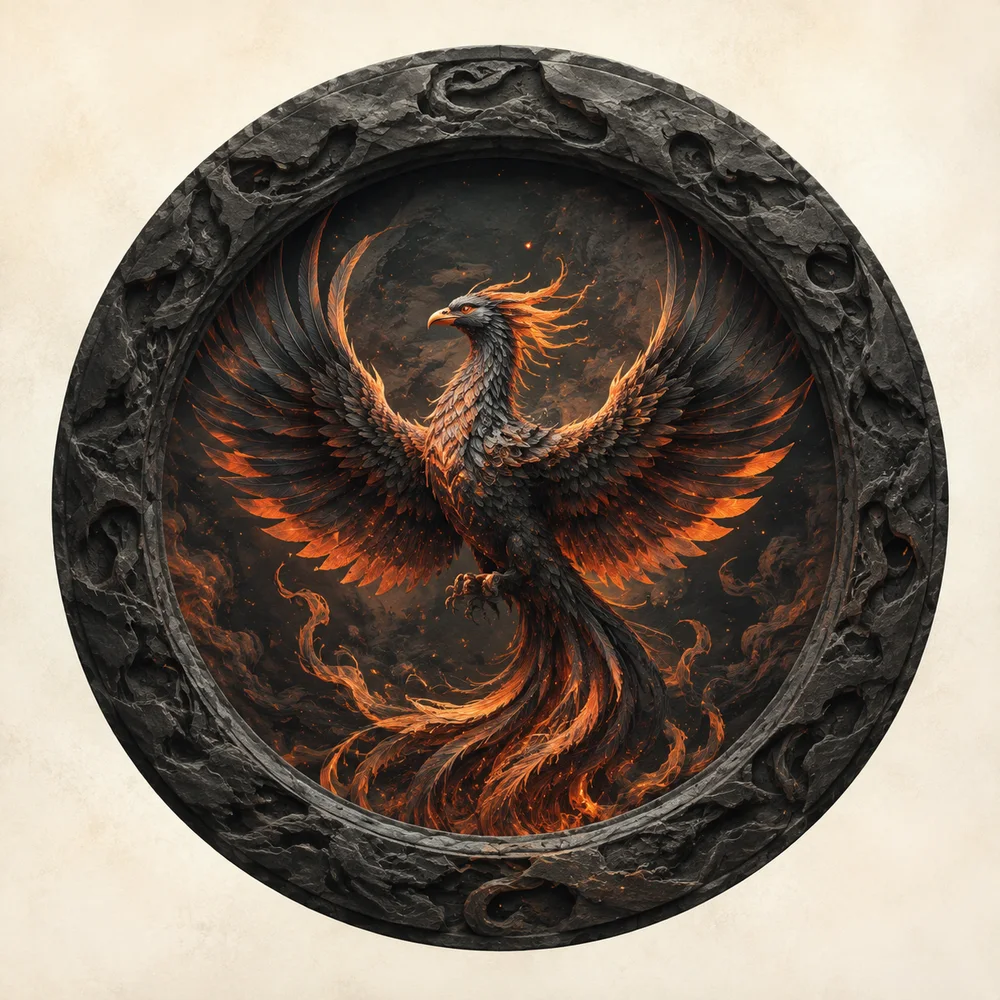
The Emblem & Fire hero is a contemporary generated illustration. Its fixed stone frame, spread wings and ember light borrow broad conventions of fantasy art. They do not reconstruct a temple object, manuscript or archaeological find. The marks around the frame are fictional decoration with no claimed language or historical origin.
Calling the image contemporary does not make it less worthy of analysis. It simply changes the questions: How does a circular boundary focus attention? How does rim light separate feathers from dark stone? Which associations come from the viewer’s experience of fantasy imagery rather than from a cited historical source?
Working takeaway
Treat “the phoenix” as a sequence of situated accounts and images; identify the source before comparing the symbol.
Sources and scope
These references support the historical and terminological framework. They do not endorse this publication or its illustrations.
- Perseus Digital Library, Tufts UniversityHerodotus, Histories 2.73
Ancient Greek literary account of the phoenix, including Herodotus’s explicit distance from the report.
- The Metropolitan Museum of ArtA Medieval Bestiary
Medieval bestiary treatment of the phoenix and its Christian resurrection reading.
- The British MuseumThe Phoenix or The Statue Overthrown
Collection record for Rembrandt’s 1658 emblematic phoenix print.
- National Gallery of ArtBurning Phoenix by Jacques Callot
Open-access collection record and visual description of a 1628 phoenix etching.
- The Metropolitan Museum of ArtPanel with a Phoenix and Birds in a Rock Garden
Collection record for a late Ming Chinese tapestry; useful for keeping the fenghuang context distinct.